
Celeste had been an architect for sixteen years. She had designed buildings that thousands of people moved through every day, managed project teams, presented to boards, and handled difficult clients without losing her composure. By any professional measure she was accomplished, respected and ready for the next step.
The next step was asking for something specific. Her firm was offering her a principal role, which meant leading a team of twelve and becoming the practice's public face at industry events. A conference talk had already been floated for the spring, a five-hundred-seat auditorium, her name on the programme. And yet, sitting at her table at eleven at night, she was on my booking page writing something like: I know I can do this, I just cannot seem to feel it yet.
This is the full account of what we built together: how her chart shaped the script, what sensory anchors we chose and why, how the rehearsal rhythm was set, the tarot spread that confirmed the direction we were taking, and the practical action plan that carried her from our first conversation to the day she stepped onto that stage. At the end I will give you a self-check list so you can recognize the same patterns in your own situation.
The brief: what Celeste wanted and what she was carrying
Celeste's intake form covered three things. First, the professional goal: accept the principal role and deliver the conference talk with real confidence, not performed confidence. Second, the thought pattern she kept noticing: every time she pictured herself at the lectern or in a senior-leadership meeting, a small voice offered an alternative narrative. Not catastrophe, nothing dramatic, simply a consistent quiet suggestion that she was perhaps more comfortable behind the work than in front of it. Third, the resource she already had: she knew the material cold. She had given informal presentations dozens of times. The gap was purely in how familiar the big-stage scenario felt.
She also flagged that she was a visual thinker. Architecture trained her to hold a three-dimensional space in her mind, walk through it mentally, and notice details before anything was built. That information shaped the entire programme. A visual thinker does not respond best to abstract affirmations; she responds to specifics she can see, hear and feel in the imagination. So from the start I knew the script would be rich in sensory detail: the texture of the stage floor, the temperature of the lights, the sound of applause tapering into attentive quiet.
Her chart: what the placements told me about the real task
Celeste is a Capricorn Sun with a Virgo Moon and a Scorpio rising. That is a heavily earth-and-water chart. Earth in astrology brings practicality, mastery and the willingness to do the work properly. Water brings depth, perception and the ability to read a room accurately. Put those two elements together and you have a person who is formidable, whose authority is real and earned, and who tends to understate rather than overstate her own capability.
- Capricorn is the sign of earned mastery. Its Sun is not loud, but it carries real weight. People with this placement are often taken more seriously by a room than they take themselves.
- The tenth house governs public role and reputation. A Sun placed there natally means professional visibility is actually part of her path, not an accident or an imposition.
- This is the placement that told me the stage was already hers in chart terms. The programme's job was to make her feel what the chart already showed.
- A Virgo Moon is precise, self-correcting and attuned to detail. It is an excellent quality in an architect and a thoughtful leader. In a pre-performance mindset, the same precision can tip into over-preparation, so the script needed to give it something accurate and settled to rest on.
- The eleventh house is the part of the chart about community, peers and being recognized by a wider audience. Her Moon sitting there suggested that her professional community's regard mattered to her very much, which made the stakes of the conference talk feel larger than an average presentation.
- The script needed to address this directly: not by silencing the editor, but by giving it accurate information about the outcome.
- Scorpio rising meets the world with intensity, depth and a quality of attention that people notice. Audiences tend to pay close attention to Scorpio-rising speakers because the presence is magnetic.
- Celeste was almost certainly more compelling on a stage than she felt from the inside. That is a common theme for this rising sign: the internal experience is one of careful calculation, while the external impression is of controlled power.
- Naming this in the programme, specifically and accurately, was one of the most effective moves we made.
- A trine is a smooth, supportive angle between two planets. Saturn trine Sun means her discipline and her identity support each other: she works hard and it looks natural, she prepares carefully and the preparation does not show as stress.
- This aspect told me the programme would compound well. A person with this pattern does the daily practice and keeps it up without forcing, because the habit of returning to something is already wired in.
One more placement that shaped the whole script: her Mercury in Sagittarius. Mercury is the planet of communication, and in Sagittarius it thinks in big pictures, is naturally eloquent when speaking about ideas it believes in, and loses energy when forced into the very small and procedural. This was the key to her actual style on stage. She did not need to be a polished performer; she needed to speak the way she already thought, in expansive, confident, idea-led language. The script would not train her to be someone else. It would give her a clear internal experience of being fully, expansively herself in front of five hundred people.
The thought patterns: naming what was running in the background
Before I write a single line of a visualization script, I spend time with what the client calls the unhelpful pattern, so I understand its actual shape. Celeste's was not stage fright in the traditional sense. She was not imagining disaster. She was imagining competent performance that somehow felt hollow, like she was executing the job without inhabiting it. The internal experience she wanted was not simply to get through the talk. It was to stand at the lectern and feel that she belonged there, that the room was hers, that every word was coming from the real Celeste rather than a well-prepared version of her.
I also noted the specific trigger point. The hollow feeling appeared most strongly at the moment she imagined walking to the lectern, before she had said a word. Not during the talk, not after: the approach. That is useful information. It meant the script needed to spend meaningful time on that specific moment, making it familiar, kind and fully inhabited before moving into the talk itself. We would rehearse the walk more than the speech.
Building the script: three layers of the programme
The script I wrote for Celeste had three layers, each serving a different function. I want to describe them clearly, because the structure is the same for every programme I build, even though the content is always completely different.
- Layer one
The arrival and the body
The first few minutes of the practice settle the nervous system and direct attention inward. For Celeste, this used the sensory detail her architectural mind was already trained to work with: the weight of her feet on a solid floor, the temperature of a room, the quality of light. Her Virgo Moon needed accuracy here, not vague softness, so the script was specific. The floor was cool and firm. The stage lights were kind from above. The room held five hundred people who had chosen to be there. Each detail was chosen to give the Virgo Moon something true to settle around rather than an abstraction to keep circling.
- Layer two
The walk and the claim
This was the core of the work. A slow, detailed mental rehearsal of the walk from the wings to the lectern, experienced fully from the inside: the physical sensation of each step, the growing sound of the room, the moment of arriving at the lectern and placing both hands on it. We anchored a specific sensory cue at that moment, a physical feeling in the hands when they touched the lectern, so that on the real day her body would recognize the sensation as something already known and already comfortable. That is what a sensory anchor does: it makes the novel feel familiar by giving the body a memory of it before the event happens.
- Layer three
The talk and the close
The final section moved through the talk itself, not as a rehearsal of specific words but as an experience of speaking with complete ease, of the room responding warmly, of the Q and A going well and her answers coming out clean and authoritative. The Scorpio rising's quiet magnetism was named aloud in the script: the room pays attention to you because you are worth paying attention to. That specificity, grounded in the chart, was not flattery. It was accurate information delivered in a format the brain could absorb and keep.
Sensory anchors: the four we chose
Sensory anchors are the most practically useful part of a visualization programme, because they are portable. You can take them onto a real stage, into a real meeting room, into any high-stakes moment, and they work because your nervous system has already associated them with ease and capability. Here are the four we chose for Celeste, and the reasoning behind each.
| Anchor | Where it is used | Why it was chosen |
|---|---|---|
| Both hands on the lectern | The moment of arriving at the lectern before speaking | Grounds the body at the exact trigger point |
| Three slow breaths before the first word | The transition from silence to speaking | Creates a repeatable bridge between preparation and delivery |
| The physical weight of a well-made notebook in the bag | The walk to the stage before going on | Tangible object familiar from sixteen years of project work |
| One specific sentence spoken in the mental rehearsal | The opening line of the talk, rehearsed until it felt automatic | Breaks the silence with something already known and trusted |
The notebook anchor is worth explaining further. I ask every client for an object that already holds positive professional associations, something they have carried into situations where they performed well. For Celeste this was a particular kind of sketchbook she had used since her first year of practice. It was not going to be opened during the talk; it was just going to be in her bag. Its weight and texture were already associated with sixteen years of good work. Taking it into the visualization, and then taking it to the real conference, made the new environment borrow authority from the old one.
The tarot spread: confirming the direction before we went further
I pull a tarot spread at the midpoint of building a programme, once I have the chart read and the script drafted but before I record anything. I treat the spread as a second opinion from a different angle. If the cards and the chart are pointing the same way, I proceed with confidence. If they disagree, I slow down and look more carefully. For Celeste they agreed clearly.
I used a six-card spread in two rows of three: the top row about the present situation and what is ready to move, the bottom row about the programme itself and the outcome it is pointing toward.

Established, capable, resourceful. This is exactly the card I would choose for a senior architect with sixteen years behind her. The Queen of Pentacles has built something real and she knows it. The programme was not creating authority; it was helping her feel what was already there.

Visibility, warmth, being fully seen and recognized. The Sun in this position told me the moment of stepping into the light was fully available to her, not just possible in principle. The energy for it was already present and moving.
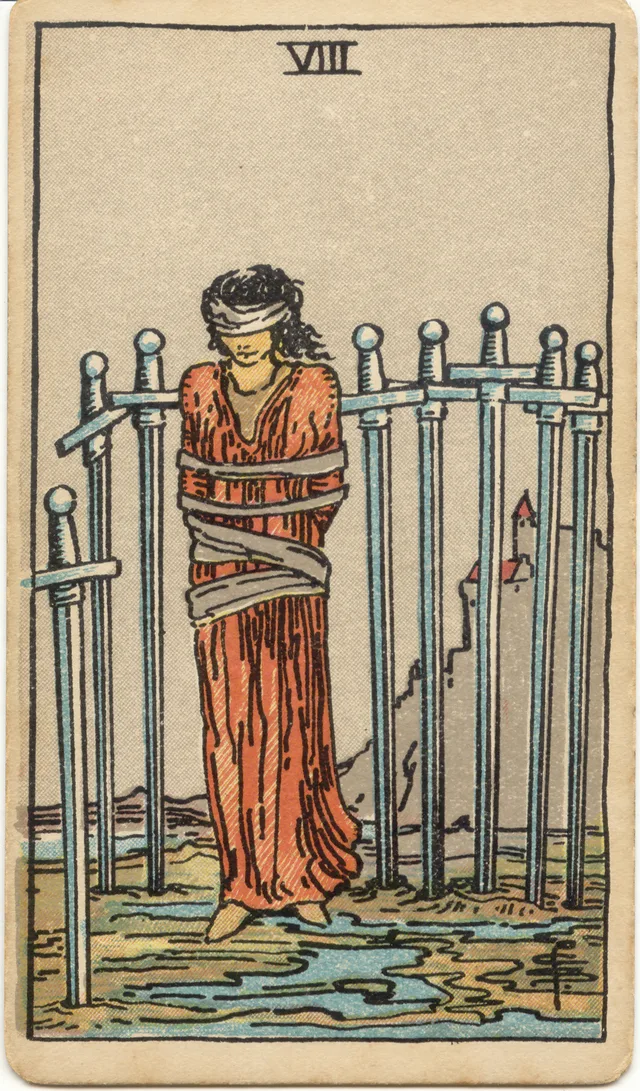
The Eight of Swords shows a figure standing still, loosely bound, who could step free with one decision. The binding is not external; it is the belief that leaving the familiar position is risky. This matched the thought pattern she described precisely. Nothing was actually holding her in place.
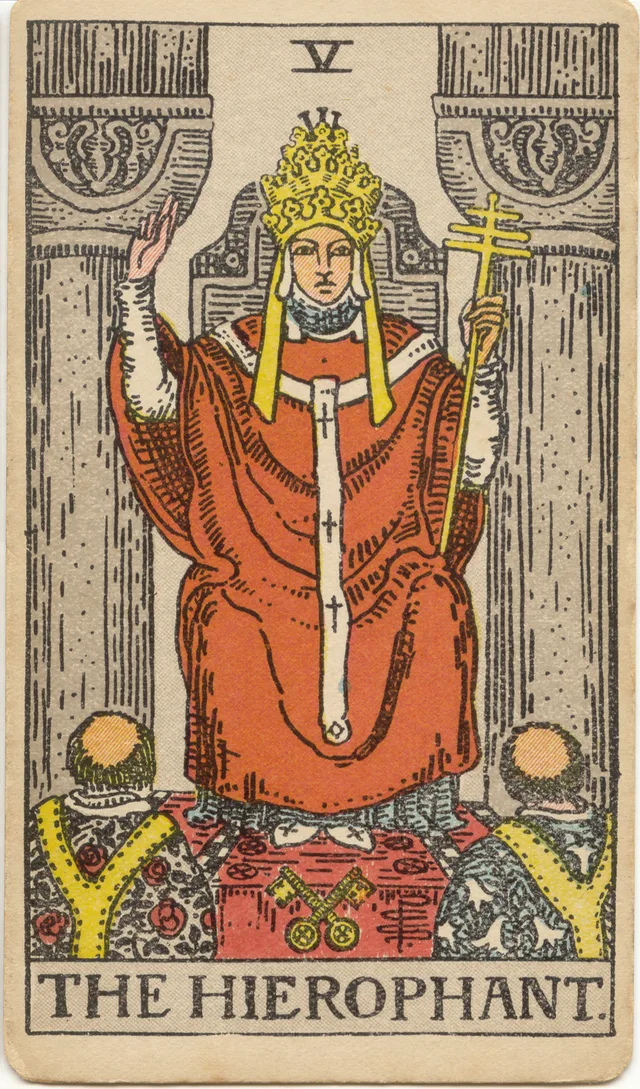
Structure, method and a trusted framework. A bespoke practice provides exactly this: a reliable, repeatable form she can return to every morning. The Hierophant in this position confirmed that a structured daily method was the right tool for this particular situation.
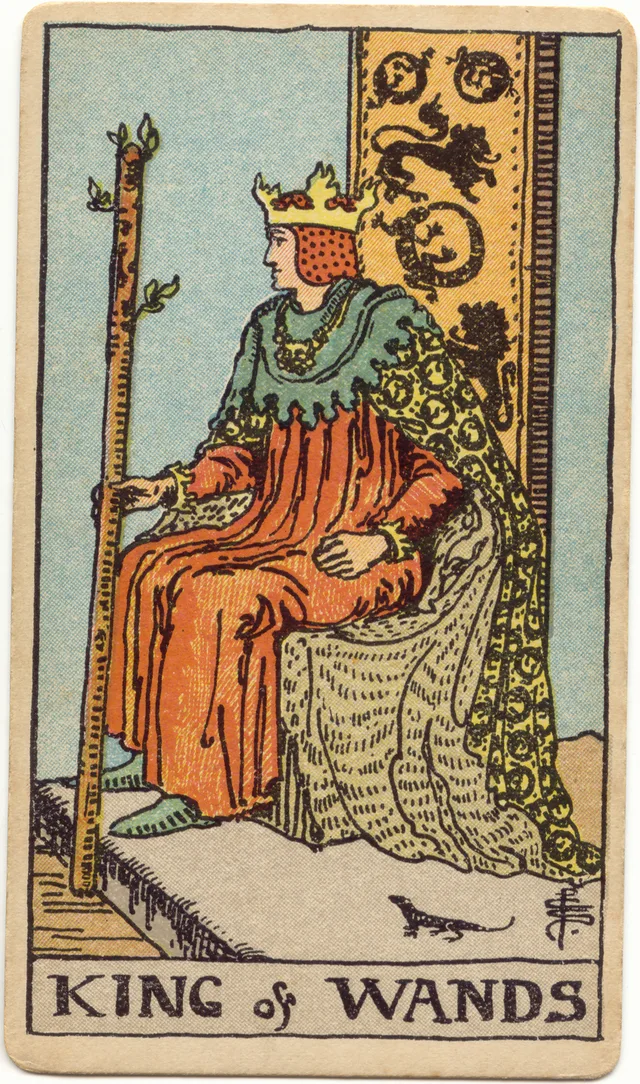
The King of Wands leads with vision, commands a room with warmth and takes up space confidently. He is the senior figure who speaks first and is listened to. This was as direct a card as the spread could have given for her conference talk and her new leadership role.
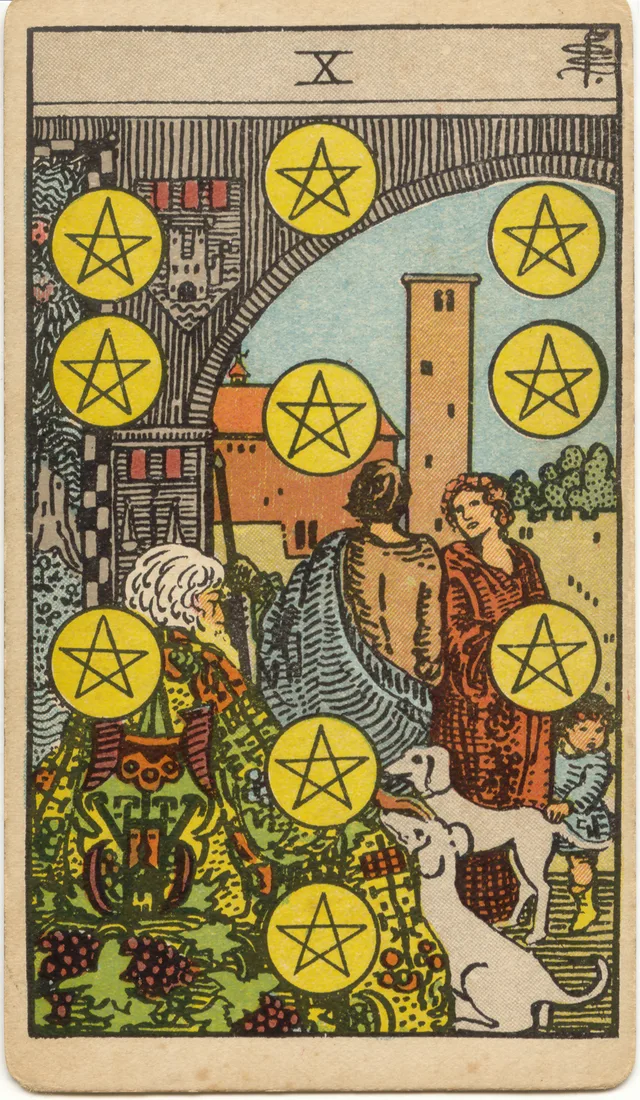
Long-term solidity, a legacy built to last. The Ten of Pentacles in an outcome position speaks to something that does not just go well on one day but compounds into something larger. The role accepted, the reputation built, the work continuing to matter over years.
Six cards, two rows, one clear direction. The chart said the stage was hers by placement. The cards said the energy for it was already moving. When two methods agree that clearly, the main thing left to do is build the practice and use it.
The rehearsal rhythm: how she used the programme
A visualization programme is only as good as its consistency. A single listen, however vivid, does not build a new neural pathway. The pathway forms through repetition: the same sensory experience, reliably available, returned to often enough that it becomes the brain's first response to the relevant situation. So once the programme was delivered I gave Celeste a specific rehearsal rhythm, calibrated to the ten weeks between receiving the recording and the conference date.
- Weeks one and two
Daily listening, morning only
Before any other screen, before email or news. The brain is most receptive to new imprinting in the first thirty minutes after waking, when it is still in a light theta state. Ten minutes of practice during this window is worth more than forty minutes in the middle of the afternoon. She used the twenty-minute version of the programme during this phase.
- Weeks three through seven
Five mornings out of seven
Once the script was familiar enough to feel expected rather than new, I asked her to drop to five sessions per week and to add one brief mental rehearsal during an existing routine: making coffee, taking a shower, the first few minutes of the commute. The goal was to distribute the imprinting throughout the day rather than concentrating it in one slot.
- Weeks eight and nine
Daily again, with the sensory anchors practised separately
Two weeks before the conference, daily listening resumed, and she added one short drill each day: placing both hands on a firm surface and running through the three slow breaths, exactly as they would happen on the stage. Separating the anchor practice from the full visualization session makes the anchors more reliable under real conditions, because the body can access them without needing the full script to be running.
- The day before
One listen only, then rest
Not two, not three. One final full session the evening before the conference, then no further mental rehearsal. Over-rehearsal in the final twenty-four hours raises the activation level of the nervous system rather than settling it. The work was done. The final session was a closing, not a cramming.
The outcome: what happened at the conference and after
Celeste gave the conference talk. She reported two things, which between them are exactly what this programme is designed to produce.
First, the walk to the lectern felt familiar. Not easy in the sense of effortless, she was aware of the room and the scale of it, but familiar. Her body recognized the lectern when her hands touched it. The sensory anchor worked exactly as it was designed to: the novel felt known. She placed both hands, took the three breaths, and opened with her prepared first sentence. After that, she said, she was simply talking about architecture, which she had been doing fluently for sixteen years.
Second, she accepted the principal role. The chart had shown the tenth-house Sun all along, the professional visibility was always part of her path; the programme gave her the internal experience that made saying yes feel correct rather than brave. She described the decision not as something she overcame but as something that had simply become obvious.
She also used the programme again six weeks after the conference, with one minor adjustment to the script for the context of a leadership meeting rather than a public stage. This is the other advantage of a bespoke recording over a generic one: once you have the structure and the sensory anchors established, adapting them for a new context takes very little work.
What this looks like as a practical plan
If you are reading this because you recognize something of Celeste's situation in your own, here is the practical shape of what the programme involves, from application to delivery.
- Step one
The application
A short written application describing where you are and what you want the programme to change. I read every application personally and reply within 48 hours. If I think a different reading would serve you better first, I will say so directly and point you there.
- Step two
The intake and the chart
Once we are both sure it is the right fit, you send me your birth details and a clear description of the goal and the thought pattern you want to shift. I read your chart, draw your tarot, and identify the specific placements and patterns that will shape the script.
- Step three
The script and the anchors
I write the programme from a blank page. Your sensory anchors are chosen for your specific goal and your specific chart. I confirm the structure with you before recording so nothing is a surprise.
- Step four
Delivery and rhythm
You receive the finished programme as an audio or video file, yours to keep. I send a one-page rehearsal rhythm guide with it, calibrated to your timeline. The daily practice takes ten to thirty minutes depending on the length you chose, and it fits a morning before the rest of the day begins.
- Step five
The follow-up
Most clients return with a brief update after their target event or decision. I welcome that. If the programme needs a small adjustment for a follow-on goal, we discuss it from there.
Self-check: is this programme right for your situation?
Use this list to assess whether what Celeste experienced matches your own position. The more of these that apply, the more directly this programme addresses what you are working with.
- You have real skill and experience in your field. The gap is not knowledge or ability; it is the internal feeling of belonging in a bigger or more visible role.
- You notice a specific moment where the unhelpful thought pattern shows up most strongly: walking into a room, opening your mouth to speak, being introduced in a formal setting. A bespoke script can be written precisely for that moment.
- You have a target event or decision that is three to twelve weeks away. That is the ideal window for a visualization programme to do its compounding work properly.
- You can commit to a daily practice of ten to thirty minutes in the morning, at least five days a week. The programme works through consistency, not intensity.
- You are willing to share your birth details for the chart layer and be specific about your goal in the intake. The more accurate your description, the more precisely the script can be written for you.
- You want a practice that is built for your situation once and used for months, not a reading you receive and set aside. The recordings are designed for daily return, not single-session insight.
- You are looking for a tool that addresses both the chart layer (where your authority and visibility actually live in your natal placements) and the mental layer (the thought pattern that is running a competing narrative). Both together are more effective than either alone.
The Mind Programming and Visualization programme is application-only at $2,999. It is the most personal work I do, and I take on a small number at a time so each one gets the attention it deserves. If the application is not the right fit, I will say so and suggest what is.