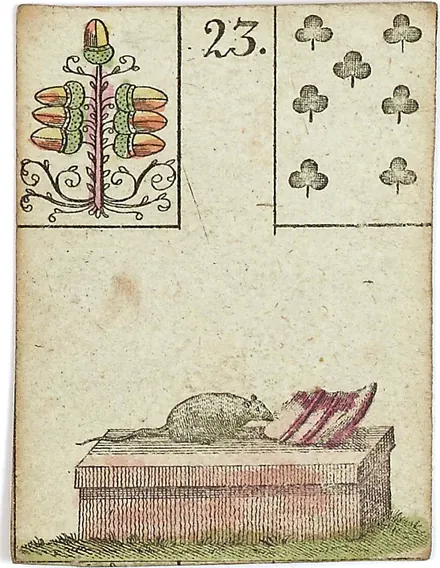
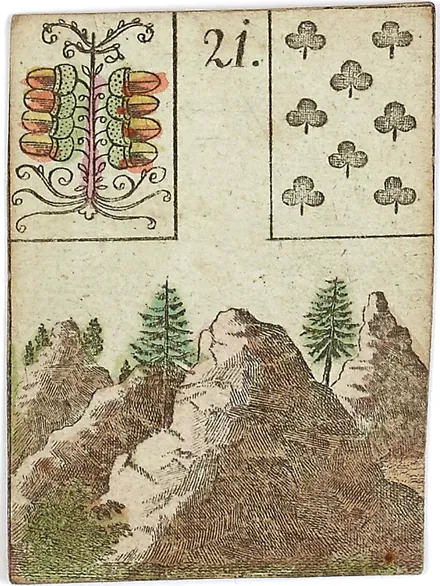
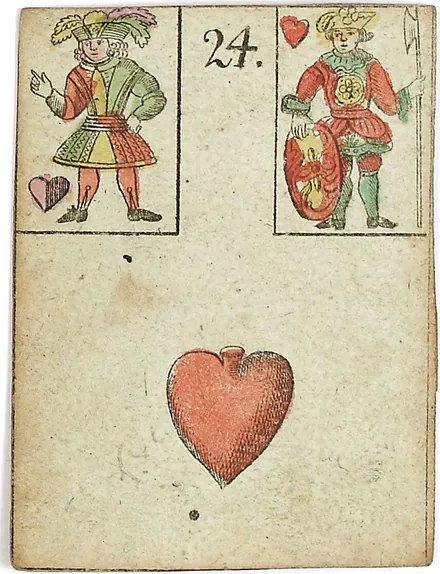
The Crossroads Lenormand card meaning
The Crossroads, printed as Die Wege, is card 22 of 36 in the Lenormand. The Crossroads, or Paths, shows more than one way forward. It is a card of choice and the freedom that comes with having options.
What The Crossroads is about
The Crossroads is card 22, sometimes called the Paths or the Ways. Hechtel's picture shows a road splitting into different directions through the landscape. In the Lenormand, it's the card of choices, options and decisions. It's not about right or wrong paths. It's about the fact that there's more than one way to go. Its playing-card inset is the Queen of Diamonds.
In everyday life
The Crossroads card shows up when you're facing a decision, big or small. It invites you to look at your options clearly instead of feeling stuck. Sometimes there are more choices than you realise. Sometimes the hard part isn't the choice itself, but accepting that choosing one road means leaving another behind. That's okay. Most choices can be adjusted later. It can also help to remember that not choosing is a choice too. Sometimes staying at the crossroads for too long becomes more tiring than any of the roads. If you've been stuck for a while, it might be time to just pick a direction and walk a little way down it to see how it feels.
22. The Crossroads Maybe you're torn between two job offers. Writing down what matters most to you, like money, location, people or growth, and scoring each one could make things clearer.
22. The Crossroads Or you're deciding what to do this weekend and feel paralysed. Picking one and committing, without overthinking, can be a relief.
The Crossroads in the main areas of life
In love and relationships
In love, the Crossroads is a choice between paths. For example, if you're deciding whether to move for a partner's job, write out what each path means for you both, practically and emotionally. The Crossroads reminds you that you have a say. Choosing on purpose feels better than drifting into one road.
At work and in study
At work, the Crossroads points to options: two job offers, two approaches, two directions. Say you're torn between a safe role and an exciting risky one. Talk to someone on each path. The Crossroads favours gathering real information and then making a choice instead of waiting for one to vanish.
With money and resources
With money, the Crossroads asks about financial choices. For example, if you're choosing between paying off debt and saving, look at the interest rates. Often paying the costlier debt first makes more sense. I'm not a financial adviser, so check big decisions with one.
Lenormand cards are traditionally read upright. Meaning comes from the neighbouring cards, not from which way up a card lands.
Things to try today
- Write down a decision you're facing and list at least three options, even unlikely ones.
- For each option, note one thing you'd gain and one you'd give up.
- Make one small decision quickly today, just to practise choosing.
Which options am I weighing, and which one fits my values rather than my fears?