Five of Wands Tarot Card Meaning
The Five of Wands depicts scrappy, noisy competition: five figures brandish staves in what looks less like a battle than a disorganised argument at rehearsal. Nobody is clearly winning, so the image can prompt reflection on competing priorities, viewpoints, or demands. It does not prove danger or tell you which disagreement deserves your effort; context and conduct do that.

What's pictured on the card
Five young figures brandish their wands in the air, each dressed differently, seemingly caught mid-scuffle. Nobody looks badly hurt, and the staves are more tangled than swinging for blood, so it comes across like a messy practice bout on open ground. Their bright, mismatched clothes hint at clashing viewpoints rather than genuine enemies. It's messy, loud, and a little comedic, capturing the friction of many wills pulling in different directions all at once.
Five of Wands upright: the core meaning
In the Five of Wands, five figures wave their staves in a scrappy, disorganised tussle. Today may bring friction, clashing opinions, or a scramble of competing demands. It's noisy but rarely as serious as it feels. Find the useful spark in the disagreement, stay good-humoured, and don't waste your fire on battles that don't matter.
There may be a low hum of frustration today, the kind that comes from too many voices, too many small demands, and not enough room to hear your own. You might feel defensive, or braced for an argument that hasn't quite happened. Underneath the irritation is often something simpler: you want to be understood, and it's tiring to keep proving your point. That prickliness isn't a flaw, it's a sign you care, and that you're stretched a little thin.
If jostling or disagreement appears today, try not to take it personally. Before entering, ask whether the friction matters to your goal or is simply loud. At work, competing ideas can be useful when people can listen and respond. In relationships, resist scoring points and name what you need. With money or family, seek a resolution rather than assuming one steady voice will settle the room. Step out when the exchange is unsafe or unproductive.
Three simple ways to work with this card
- Before you jump into any friction today, take a breath and ask yourself whether this particular battle is actually yours to fight.
- Burn off restless energy with a brisk walk or workout, so it doesn't spill onto someone you love.
- In one tense exchange, try saying 'here's what I actually need' instead of defending or scoring a point.
Which disagreement today is worth your energy, and which is just noise?
What the Waite-Smith image actually shows
Five figures, not two. This is not a duel. Five people wear different clothes and hold their staves at different angles. The variety can support a reading about several viewpoints, roles or priorities in one situation rather than two fixed sides. The image does not establish that any figure is sensible, malicious or responsible.
The staves: raised, tangled, not landing. The five wands are raised, waved and crossed, but no figure is visibly struck. That detail makes the scene look like an uncoordinated argument or rehearsal rather than a completed fight. The image can prompt questions about competing demands and effort; it cannot assess danger in a real situation.
The open sky. The figures stand outdoors in daylight on ordinary ground. The uncluttered setting keeps attention on their visible actions instead of a hidden setting. It can support discussion of an obvious disagreement, but the card cannot prove that a problem is minor, transparent or safe.
The number five, and the missing winner. In tarot, five is often used for disruption after the relative stability of four. In Wands, that convention can frame several motivated people with different aims. No figure is shown standing over defeated opponents, so the illustration focuses on activity rather than a result. It cannot show who will prevail, whether competition is productive or how a reader should respond.
The upright Five of Wands in full
The Five of Wands can provide language for competing demands, clashing opinions and energetic collaboration. Disagreement sometimes helps people test an idea or clarify priorities, while sometimes it consumes time without changing the decision. The card cannot establish which situation applies. Review the stated goal, who is responsible for what, the quality of communication and the cost of continuing.
There is also a creative dimension. Several ideas may compete during a brainstorm or a project whose approach is still being decided. This can be useful when people can explain their proposals, listen and make a decision; it can be tiring when there is no process for choosing. The card invites that distinction without promising a better result.
What it is not saying: the Five of Wands does not prove that someone is attacking you, that your position is under threat or that you should confront everyone around you. The scene shows visible disagreement, but only the actual circumstances can establish risk. Compare the importance of the issue with the time, money and emotional effort required.
The reversed meaning
Reversed, the Five of Wands can symbolise disagreement that is no longer being discussed openly. A concern might be postponed, communicated indirectly or left unclear, but the card cannot establish passive aggression, concealment or a future escalation. Ask what has been said, what remains unresolved and which conversation is safe and wanted.
A second reversal theme is an avoided conversation about different approaches, responsibilities or a perceived unfairness. Rather than assuming that a conversation must happen, consider consent, power, safety and the likely purpose. Compare the cost of delay with the cost of addressing the issue through an appropriate channel.
There is also an internal version: several priorities competing for one person's attention, making commitment difficult. The reversed image can prompt a list of options, constraints and trade-offs rather than asking which deserves to win. It may also be used to reflect on a quieter period after disagreement, but the card cannot establish that a conflict has ended or been resolved.
In practice, nearby cards may shift the discussion towards communication, competing priorities or a possible pause. They do not identify a hidden disagreement, establish resolution or show that the hardest part has passed. Use the spread to generate questions, then check those questions against events and reported experience.
In love & relationships
In a relationship, the Five of Wands can frame increased friction, more frequent arguments or both people asserting needs at once. That pattern may reflect a useful negotiation, repeated unresolved issues or a situation that feels unsafe; the card cannot distinguish them. Look at what is said, whether both people can participate freely and whether repair follows disagreement.
In love, use the image to compare a discussion that adds information with one that repeats without an agreed change. Frequency, content and conduct provide that evidence. For someone single, it can frame dating that feels competitive or comparison-driven, but it cannot establish another person's intentions. Decide which communication and boundaries match what you want rather than treating dating as a contest.
Disagreement can add useful information or create more strain; the people involved and their conduct provide the context.
- A direct conversation that names a real issue and opens negotiation
- Asserting needs suppressed for too long
- Working through a genuine difference rather than papering over it
- Competing playfully in a way that energises both people
- The same argument cycling again with no new ground covered
- Competing to win a point rather than to be understood
- Letting small irritations build instead of addressing them small
- Using discord to keep distance when closeness feels uncomfortable
Career
At work, the Five of Wands can frame a competitive hiring process or a workplace with competing priorities. In a selection process, compare the role requirements with your experience, prepare examples and ask for the process and criteria; the card cannot show how other candidates will perform or whether you will be chosen.
In a busy workplace, list which decisions are yours, which require collaboration and which belong to another role. Clear responsibilities and respectful communication are more useful than joining every disagreement. A creative project may need time for competing ideas, but it also needs criteria and a decision owner; the card cannot show that the process will be productive.
For a beginner example, imagine three coworkers choosing a launch date. One wants speed, one needs testing time, and one is waiting on a supplier. Write each constraint next to its owner, identify the missing facts, and give one person authority to choose after a stated deadline. That turns noise into a process: the disagreement remains visible, but everyone knows which question is being answered and how to raise a serious concern. The card offers a picture for that exercise, not a verdict about who is difficult.
Money
In a financial reading, the Five of Wands can raise a marketplace with several providers, prices or terms. Comparison may be useful, but competition does not guarantee better terms or a suitable product. Check fees, exclusions, affordability, risks and independent advice before choosing.
It can also frame financial friction in a household, partnership or family arrangement. Write down the competing priorities, shared obligations and decision rights, then discuss them with the relevant people. The card cannot tell you who is reasonable or whether an agreement is fair.
Health & wellbeing
For wellbeing, the Five of Wands can evoke many simultaneous demands and difficulty prioritising. It cannot establish exhaustion, a health cause or whether activity is productive. Ask what the person reports, how daily function is affected and what support is appropriate.
The illustration may prompt someone to notice physical tension such as a tight jaw or shoulders, but the card cannot link a symptom to conflict or say that relaxation will help. Persistent or concerning symptoms belong with a qualified clinician; practical workload and stress questions can be considered separately.
Life events & big decisions
Around a major decision, the Five of Wands can frame several options or people competing for attention. Make a written comparison of goals, costs, deadlines, risks and missing information instead of trying to respond to every opinion at once. The card cannot tell you which option is strongest.
It can also frame a family or partnership decision where people want different outcomes. Separate shared interests from non-negotiable boundaries and decide whether a facilitated conversation is appropriate. In a competitive process for a home, job or contract, assess your own affordability, evidence and terms; the card cannot establish that your case is strong or the process is manageable.
Contracts, deals & signatures
The Five of Wands beside a contract can frame competing interests and visible disagreement. Most negotiations contain different priorities, but the card cannot assess whether the process is smooth or whether an issue will resolve itself. List each party's material interests and put agreed changes in writing.
In an active negotiation, identify non-negotiable terms, flexible points and the evidence behind each request. Do not concede under pressure without checking the effect; do not treat every disagreement as a threat. With several parties, record responsibilities, approvals and unresolved issues before signing. Independent advice may be appropriate for a high-stakes agreement.
Entrepreneurship & business
In business, the Five of Wands can frame a crowded market with similar offers and many voices. Compare customer needs, evidence of demand, costs and the specific value of your offer; the card cannot establish that a market is viable or that differentiation will work.
Internally, it can prompt an audit of competing priorities, decision ownership and meeting load. Clear roles and decision rights may help, but the card cannot diagnose a team problem or prescribe a structure. Creative teams can allow several ideas to develop while setting a decision date and criteria for choosing.
How it shows up in real readings
The Five of Wands beside The Chariot can place competing activity beside focus and direction; it does not show that the friction is manageable. Near The Tower, explore whether a disagreement or change needs structural attention. With Seven of Wands, compare several claims with one position or boundary, without treating the sequence as a forecast.
A reader may describe an exhausting environment and a sense of needing to respond to every disagreement. The card can support an inventory of which decisions are theirs, which are shared and which can be declined. It cannot determine whether participation comes from habit, anxiety or obligation; ask about the actual demands and available boundaries.
What does the Five of Wands mean in tarot?
What does the Five of Wands reversed mean?
Is the Five of Wands a yes or no card?
What does the Five of Wands mean for love?
Does the Five of Wands mean I'll lose a competition?
If the Five of Wands has appeared, ask which part of the current disagreement adds information and which part consumes effort without changing anything. List the decisions, responsibilities and boundaries involved. You do not need to answer every challenge, but the card cannot decide which one merits your time.
A small daily practice can support that review. The free daily draw is there each morning as an optional reflection on attention and priorities. It cannot show what a disagreement requires or predict how a conversation will go.
The Five of Wands can represent competing energy or several demands, not an instruction to fight everyone. Identify the one issue that matters, define a useful goal, and protect your energy rather than reacting to every challenge, reserving it for what matters.
Related cards and themes
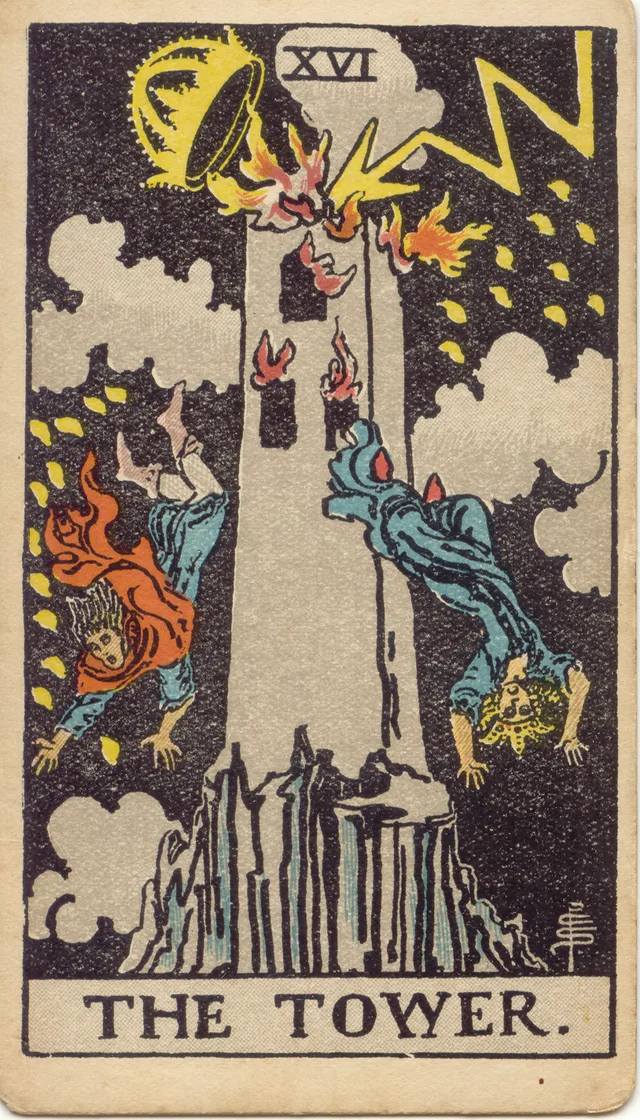
The Tower
The Tower represents major disruption as a theme, while the Five of Wands can help examine smaller disagreements before or after a disruptive change.
Read this card's meaning →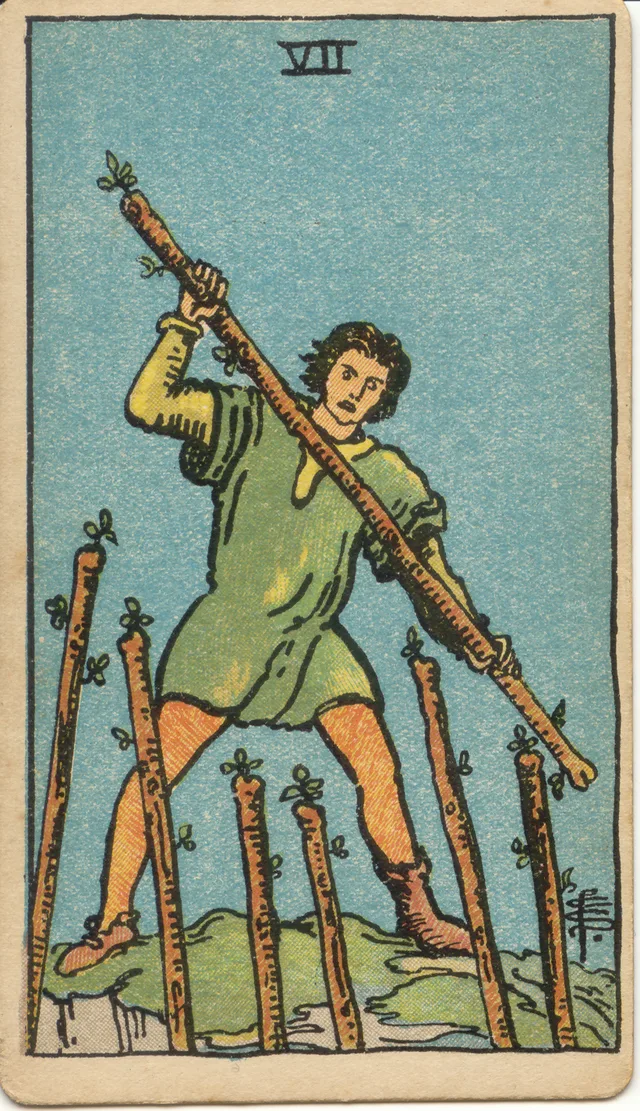
Seven of Wands
The Seven of Wands narrows the Five's competing claims into a question about one position, boundary or responsibility worth defending.
Read this card's meaning →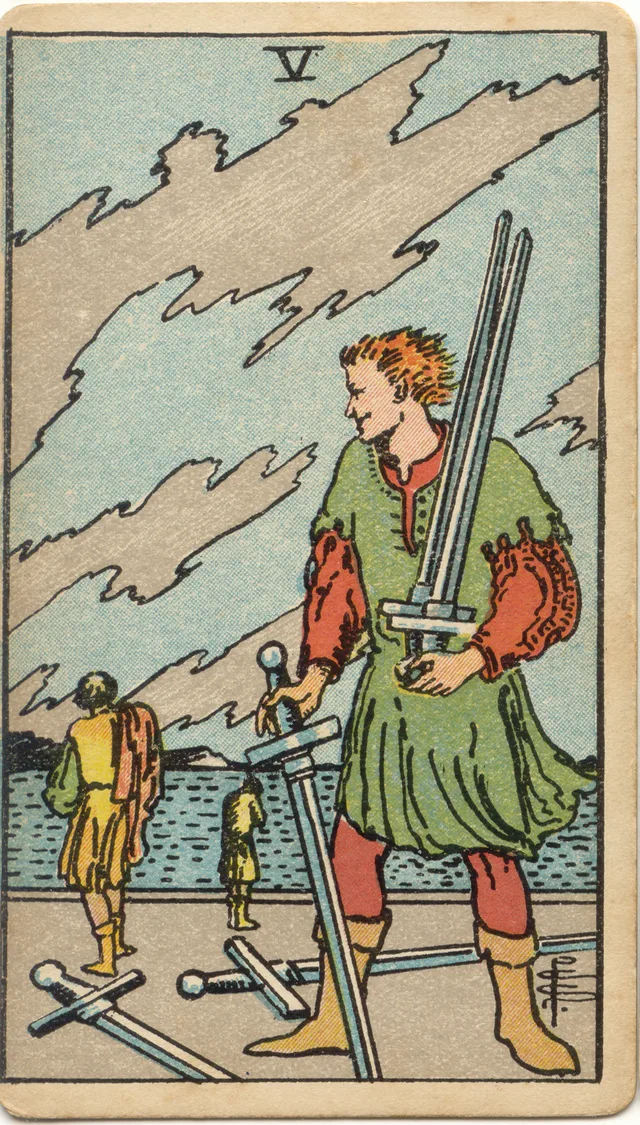
Five of Swords
The Five of Swords examines what can happen when competition becomes a contest to defeat someone rather than a way to address the issue.
Read this card's meaning →