Queen of Swords Tarot Card Meaning
The Queen of Swords holds an upright blade with an open hand, representing clear thinking, boundaries, and honest communication. It can prompt a direct but respectful conversation, yet it cannot prove that your interpretation is complete or that another person is acting in bad faith. Check the facts and state what you need without abandoning compassion.

What's pictured on the card
The Queen of Swords sits on a stone throne carved with butterflies and a cherub, holding a sword upright in her right hand and extending her left in welcome. Wispy clouds gather below her, a single bird flies high above, and the trees lean in a steady wind. Her face is steady and clear-eyed. Smith drew perceptive wisdom earned through experience, a woman who sees straight through pretence, thinks for herself, and offers truth without cruelty.
Queen of Swords upright: the core meaning
The Queen of Swords sits upright with her blade raised, clear-eyed and fair after everything she's seen. Today calls for clear thinking and clean boundaries, saying what you mean with warmth but no waffle. Trust your own judgement. You can be kind and direct at once; clarity is a gift you give people, not a cruelty.
A clear-headedness is settling over you today, a sense of seeing your situation without the usual fog. Beneath it you may feel a quiet firmness, a readiness to stop over-explaining or shrinking to keep others comfortable. Perhaps you've been softening your truth so long that speaking it plainly feels almost bold. Trust that steadiness. It isn't coldness; it's self-respect finding its voice. Part of you is done accepting less than honesty, from others and from yourself, and that clarity is a kindness.
Let honesty and warmth walk together today. When something needs saying, state it plainly and kindly, then leave room for a response. At work, test your interpretation against facts and other perspectives. In relationships, name what you need rather than hoping someone guesses. With money, decide from the figures rather than wishful thinking. A clear boundary can be compassionate without assuming how other people will react.
Three simple ways to work with this card
- Say one clear, kind sentence about what you need today, then resist the urge to over-explain or soften it away.
- Set one clear boundary you've been avoiding, and let it be a full sentence with no apology attached.
- Write down what your gut already knows about a situation, and trust that read even if others are hedging.
Where could clear words serve you and others today?
What Pamela Colman Smith gave her
The upright sword. In her right hand, the Queen holds the blade vertically rather than pointing it at anyone. The pose supports themes of clear language, standards, and deliberate action. It does not prove that a real person's judgement is accurate or that a boundary is fair.
The welcoming left hand. Her other hand reaches outward with an open palm. This detail can balance the sword's precision with listening and receptivity. It does not establish that a person is welcoming, compassionate, or willing to hear a particular argument.
The butterfly-carved throne. Her stone seat is carved with a butterfly and a cherub. Butterflies can support symbolic themes of change and a developing viewpoint. The image does not show what experiences shaped a reader or establish that clarity will be compassionate.
The single bird above. One bird flies high in the open sky. The detail can support reflection on independence and perspective, but it cannot establish that a person chooses solitude, rejects company, or has been betrayed.
The wispy clouds and the wind. Thin clouds gather behind the Queen while the bird flies above them. This visual contrast can support a discussion of seeing some information clearly while uncertainty remains. It cannot show that a reader has processed pain or gained a superior viewpoint.
The upright meaning in detail
The Queen of Swords can represent clarity shaped by experience, careful distinctions, and independent judgement. The card cannot establish what a person has experienced, whether their interpretation is accurate, or whether pain has made them more discerning. Check claims against evidence and remain open to correction.
She can prompt a reader to examine the frame offered by other people, state what is known, and form a view that can be explained. Independent judgement is not the same as certainty; invite relevant evidence and qualified review rather than treating a card as validation.
The image combines a raised blade with an open hand, which can support a communication exercise: state the observable issue, say what you need, and leave room for the other person's response. Directness does not prove that your interpretation is complete, and warmth does not require abandoning a boundary.
What she is not asking you to be: hard, unfeeling, or unfailingly correct. A clear statement can include uncertainty and an acknowledgement of impact. Review your assumptions, invite correction, and use safety and consent considerations before confronting a person.
The reversed meaning
The first reversal reading is bitterness: clear language used to wound, dominate, or prevent vulnerability. Do not use the card to infer the reason for a person's conduct. Identify the words or actions involved, state the boundary, and seek support if the exchange becomes coercive or unsafe.
A second reading is over-detachment: analysis used to avoid acknowledging emotion or impact. Include the relevant feelings as information without treating them as the only evidence. The card cannot diagnose detachment or show what a person is avoiding.
There is also a pattern of suppressing a view to keep others comfortable. Write down what you think, what you fear would happen if you said it, and what support or safety planning would be needed. The card cannot establish that silence is the wrong choice in a particular situation.
Sometimes the reversal can prompt a review of harsh self-judgement: standards applied to yourself without the same context or compassion given to others. Compare the claim with specific evidence, correct mistakes where possible, and avoid treating the card as a diagnosis.
In love & relationships
For someone single, the Queen can prompt reflection on independence, standards, and the ability to state needs without pretending. It cannot establish that a person is complete, that a future partner will appear, or that a connection will be healthier than a previous one. Let behaviour, communication, and consent inform relationship choices.
In an established relationship, the Queen can support a direct conversation about an issue that has remained vague. State observations and needs, invite the partner's response, and consider safety and timing. The card cannot establish whether a relationship can handle honesty or predict the result of a conversation.
She can also prompt review of communication labour when one person repeatedly names issues and the other avoids responding. Describe the pattern and request a specific change, then observe whether the request is respected. The card cannot prove a partner's motive or decide what reciprocity should look like.
Direct communication can clarify a relationship when it includes respect, consent, and room for both people to respond.
- The ability to state needs without treating partnership as the only source of security
- Honesty delivered with warmth — direct without cruelty
- Clear standards from self-knowledge rather than rigidity
- A direct conversation that identifies the issue and a possible next step
- Using clarity as a barrier against vulnerability
- Applying to a partner the analysis you'd apply to a problem
- Holding your ground out of pride after you've been heard
- Expecting total honesty before you've modelled it yourself
Career
In a professional context, the Queen symbolises independent judgement in strategy, editing, analysis or consulting. The card cannot certify that an assessment is accurate or show what colleagues think. Evidence, peer review and outcomes provide that evaluation.
The welcoming hand and upright sword can prompt reflection on advocacy and boundaries. The card cannot set the moment for a salary or resource negotiation. Compensation data, objectives, leverage, risk and circumstances determine the approach.
The Queen can symbolise tension between consensus and independent analysis. She cannot identify a workplace culture or the right environment. Observed behaviour, policies, outcomes and the reader's priorities provide that evidence.
For a beginner preparing a difficult work conversation, make three columns: what happened, what you think it means, and what you need clarified. Bring dates, written instructions, measurable effects, and a specific request rather than a character judgement. Practise wording that leaves room for correction, such as “I understood the deadline to be Friday; can we confirm the date and priority?” If the issue concerns harassment, discrimination, retaliation, or personal safety, use the relevant policy and support channel instead of relying on an informal confrontation. Clear language is a tool for checking a situation, not a substitute for evidence or procedure.
For example, “I need the handover notes by noon” is clearer than “you never communicate.” The first statement can be checked and answered; the second assigns a history and invites an argument.
Money
With finances, the Queen symbolises careful analysis. The card cannot ensure accuracy or protect someone from an unsuitable agreement. Use verified figures, written terms and qualified financial or legal advice.
Around financial independence, this card can prompt a review of income, access to accounts, shared obligations, and decision-making power. It cannot measure how independent someone is. Use verified figures, written agreements, and qualified advice to assess the actual situation.
Health & wellbeing
In a wellbeing context, the Queen can prompt a distinction between reported symptoms, recorded information, and assumptions. Describe changes accurately and ask qualified clinicians what they mean; the card cannot diagnose, assess severity, or replace care.
She can also prompt reflection on the strain of suppressing views or managing other people's perceptions. Name the situation, practical consequences, and support available, while recognising that silence may be a safety choice in some settings. The card cannot measure psychological cost.
Life events & big decisions
Before a significant decision, separate verified information, personal priorities, and other people's assertions. Check sources, costs, deadlines, risks, and alternatives for a move, commitment, or change of direction. Independent review can help; the card cannot establish that your first interpretation is complete.
Some decisions belong to the person affected, while trusted input can still identify missing information. Decide whose consent is required, whose expertise is relevant, and whose preference is merely pressure. The image cannot show that a reader should decide alone or reject advice.
Around transitions involving loss, the Queen can support honest language about grief, changed responsibilities, and practical next steps. The illustration cannot establish what someone has lost or how they should process it. Use support, time, and qualified care where needed.
Contracts, deals & signatures
The Queen of Swords in a contract position can prompt precise questions. The image cannot determine whether terms serve the reader. Compare obligations, rights, price, alternatives, privacy, cancellation, and independent legal or commercial review.
She can raise the question of whether terms are acceptable without answering it. Assess non-negotiables, alternatives, leverage, cost, deadlines, and qualified advice before choosing whether to exit, continue, or accept.
Around co-founder or creative partnership agreements, put ownership, duties, decision rights, payment, credit, exit terms, and dispute processes in writing. A positive relationship cannot establish fairness or replace legal structure.
Entrepreneurship & business
For entrepreneurs, the Queen of Swords can prompt a clear review of what is working and what is not. Compare revenue, costs, customer feedback, obligations, workload, and alternatives rather than treating confidence as evidence. Use the findings to set a specific review or change.
The Queen can frame difficult client conversations, declined work or pressure as themes. She cannot establish what a client wants, decide that work is unsuitable or direct a negotiating position.
In leadership, the Queen symbolises independent authority and careful judgement. The card cannot establish how a view was formed or whether an organisation values it.
How the Queen tends to show up
Beside Justice, the Queen can prompt a comparison of clear language with accountability; with The High Priestess, analysis with private reflection; beside King of Swords, independent judgement with formal responsibility. None supplies a legal or ethical judgement.
The Queen can prompt reflection on direct and softened language. She cannot show that someone has suppressed truth, compare the costs of honesty, or establish readiness to speak. The reader's account, safety, consent, and consequences matter.
What does the Queen of Swords mean in tarot?
What does the Queen of Swords reversed mean?
Is the Queen of Swords a yes or no card?
What does the Queen of Swords mean for love?
Does the Queen of Swords represent a real person?
If the Queen of Swords has arrived in your reading, ask: what do I actually know, what am I inferring, and what do I need to ask? Write the answer in concrete language, include uncertainty, and check the practical and safety consequences before speaking or acting.
The open hand in the illustration can remind you to pair clarity with respect. State the issue and need without claiming certainty about another person's motives, and remain open to information you missed. If you'd like a daily reflection prompt, the free daily draw is there each morning.
The Queen of Swords can represent honest language without cruelty. Name what is present, keep the facts distinct from a verdict, and use warmth where it helps the truth be heard.
Related cards and themes
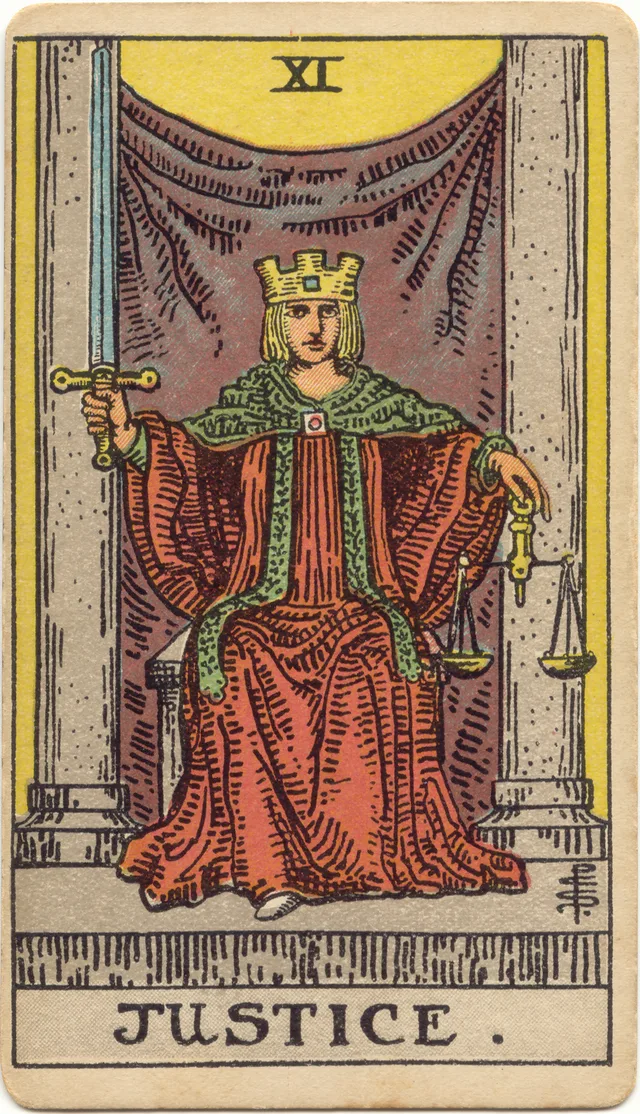
Justice
Justice focuses on balancing evidence and accountability, while the Queen of Swords focuses on clear judgement shaped by experience. Together they can prompt a careful review without supplying a legal or ethical verdict.
Read this card's meaning →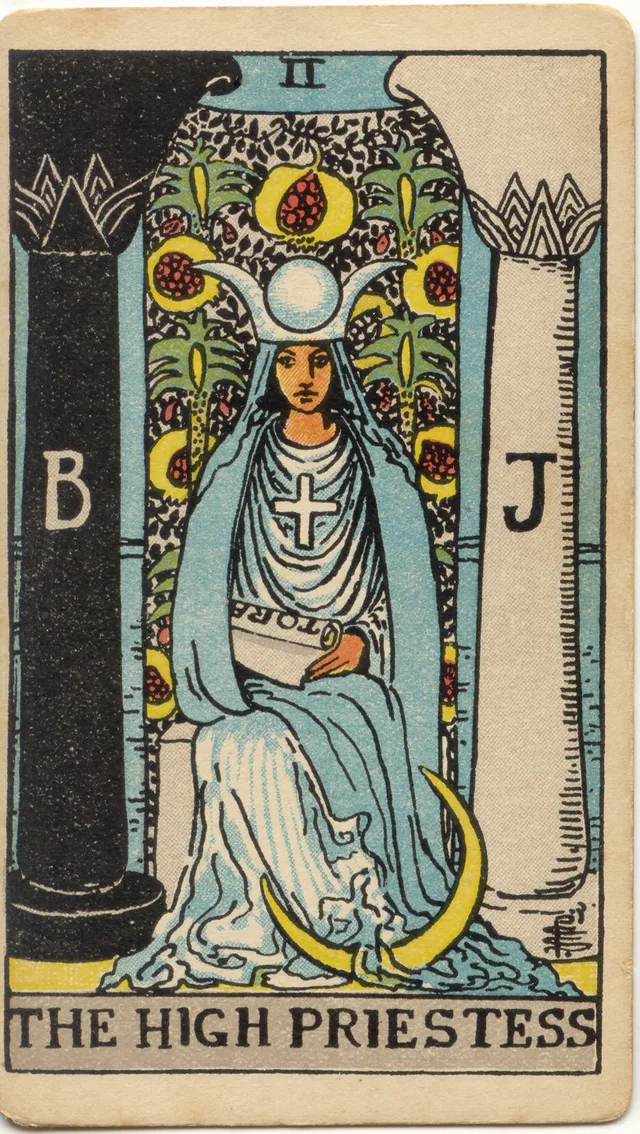
The High Priestess
The High Priestess emphasises private reflection, while the Queen of Swords emphasises direct communication. Read together, they can support deciding what is known, what remains private, and what needs to be said.
Read this card's meaning →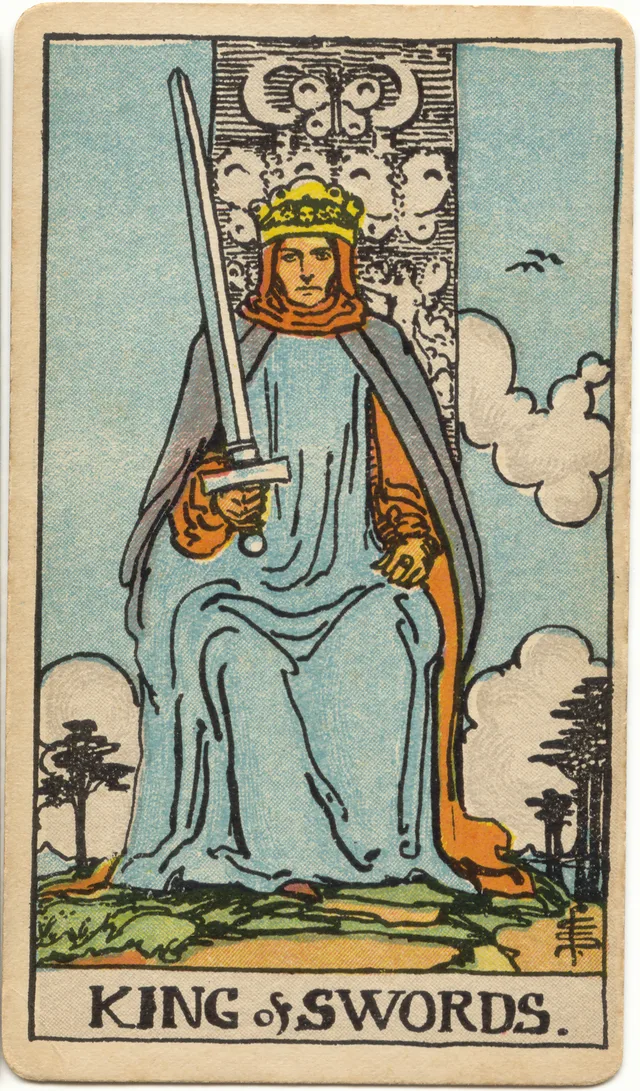
King of Swords
The Queen and King of Swords both examine clear thinking and communication. The Queen can focus on independent judgement; the King can focus on formal responsibility. Neither card proves accuracy, authority, or fairness.
Read this card's meaning →