King of Pentacles Tarot Card Meaning
The King of Pentacles represents stewardship, material responsibility, long-term thinking, and reliable provision. It can prompt you to review how resources are managed and shared, but it cannot prove that wealth, authority, or security is present. Compare costs, risks, obligations, and the evidence that a plan can last.

What's pictured on the card
A king sits securely on a throne carved with bulls' heads and clusters of grapes, his robe embroidered with vines. He holds a sceptre in one hand and rests a golden pentacle on his knee, one foot planted on a stone boar's head. A ripe garden and his castle rise behind him. Everything speaks of hard-won plenty. The image shows steady mastery, the quiet confidence of someone who has built real security and can look after it wisely and generously.
King of Pentacles upright: the core meaning
The King of Pentacles sits amid vines and gold, a steady provider who has built lasting prosperity. Today rewards grounded leadership, managing your resources wisely, being dependable, turning effort into something solid and secure. Lead by good example. You have the patience and sense to build wealth that holds, and to help others feel safe within it.
You may be feeling the weight of being the dependable one, the person others lean on to provide, decide and hold things together. There can be real pride in that competence, mixed with a quiet tiredness, or a worry about whether the security you've built is actually safe. Perhaps you rarely let yourself be the one who's looked after. That steadiness is a genuine strength. But beneath it lies a softer truth: even the most capable provider deserves support, ease and someone to lean on too.
Use grounded authority kindly. Review your resources, responsibilities, and the people who rely on you before deciding how to lead. At work, compare your long view with the actual needs and feedback of the situation. With money, steward what you have wisely and keep generosity within your means. In relationships, offer presence as well as material help, while letting others contribute. Abundance is not only what you hold; it is also the support and boundaries that keep sharing sustainable.
Three simple ways to work with this card
- Make one sensible decision you've been putting off today, trusting the good judgement your experience has earned you.
- Let someone contribute or help today instead of carrying everything yourself, even the capable deserve support.
- Share a little of your security generously, mentor, treat, or steady someone, and notice it costs you nothing.
Where could steady, grounded stewardship build something lasting today?
What Waite-Smith painted and why it matters
The throne among the vines. The King sits on a stone throne carved with bull's heads, a Taurus reference associated in tarot writing with patience, physical comfort and material concerns. Vines surround him and show a cultivated setting rather than a formal throne room. Reading the figure among the plants keeps attention on the practical work of maintaining land, income and daily resources, not on authority as an abstract title.
The vine-embroidered robe. Grape and vine patterns cover the heavy robe and repeat the plants around the throne. The visual connection can be read as a reminder that material responsibility involves knowing the everyday conditions behind a report: labour, maintenance, supply, quality and the people affected by a decision. The illustration does not establish that any particular manager has that knowledge; it supplies a useful standard to investigate.
The sceptre and the pentacle. A sceptre in his right hand represents formal responsibility, while a large golden pentacle rests on his knee. He holds the coin steadily instead of examining it with surprise. That pose can prompt questions about familiarity with budgets, tools, pay, property or other tangible matters, but the card cannot prove financial experience or competence in a real person.
The castle and the armour. A castle stands behind him and armour is visible beneath the robe. These details place comfort beside infrastructure and protection: a stable-looking result still requires upkeep, contingency planning and work that may not be visible. The picture can support a review of what protects a household or organisation; it cannot confirm that security is permanent or that the foundation is sound.
The stone boar's head at his feet. His left foot rests on a carved boar's head. Traditional readings connect the boar with appetite and force, so the detail can be used to discuss managing desire rather than pretending desire is absent. The King may value food, comfort and craftsmanship, while still asking whether spending and consumption remain deliberate and affordable.
The upright King of Pentacles in full
The King of Pentacles presents the mature end of the suit's conversation about tangible resources: material skill expressed as stewardship. The emphasis is not hoarding or display, but deciding how money, property, labour and practical care are managed and shared. In a reading, use that emphasis to ask who benefits, who carries the work and what responsibilities have been made explicit across a household, business or community.
What distinguishes this image from a simple picture of wealth is the attention to knowledge and responsibility alongside resources. It invites questions about lessons learned from good years and difficult ones, how risks were assessed, and which evidence supports a claim that a plan can endure. A calm pose is not proof that someone is secure or wise; check records, behaviour, obligations and independent advice rather than letting the vineyard stand in for evidence.
The King is not limited to rigid financial control or to money as a score. The Taurus association also brings food, comfort, craft and sensory pleasure into the discussion. Those pleasures still need a real budget and mutual consent. The card can prompt an examination of whether resources are being used in line with stated values and shared fairly; it cannot show that a person is generous, stable or entitled to control the resources.
The reversed meaning
A central reversal theme is material power used without accountability. Patience and long-term planning can become miserliness, financial pressure or provision used as leverage. In a reading, examine the actual arrangement: who can access money, who sets conditions, what happens if someone says no, and whether support creates an obligation that was never openly agreed. The card cannot establish that a giver has hidden conditions.
Another reversal theme is a break with careful process: impulsive spending, speculation without due diligence, or abandoning a workable budget under pressure. Someone may feel tired of restraint and want a dramatic release, but the card cannot diagnose that motive. Review the decision history, affordability, downside and written plan before interpreting a sudden financial move.
A further reversal theme is success treated as a reason never to adapt: expertise withheld, systems protected for one person's benefit, or an organisation unable to change because its history has become a rule. On a personal level, a long focus on earning can leave relationships, rest or pleasure underdeveloped. Instead of assuming that a person is hollow or that the resources are secure, ask what the money is meant to support and what the current evidence says is being neglected.
If the question concerns receiving money or practical support, protect choice and clarity without assuming bad faith. Keep access to essential resources where possible, document the arrangement, name repayment or decision rights, and seek qualified advice for significant commitments. A card cannot reveal whether generosity is conditional; the written terms and observed conduct need to answer that.
In love & relationships
If you are single and the King appears, material care can be a theme to explore: practical help, shared planning, a secure home or effort invested in something lasting. Those actions do not prove that a person is caring or emotionally available. Compare promises with consistent behaviour, discuss expectations and notice whether emotional attention is present alongside practical provision.
In an established relationship, the King brings long-term planning and practical commitment into focus: household finances, housing, shared goals and the work required to maintain them over the next five or ten years. That longer view still needs present attention and a fair distribution of decision-making. Discuss income differences, access to accounts, unpaid labour and whether support is being exchanged for deference. The card raises those questions; it cannot certify that an arrangement is equitable.
Long-term planning and practical support can help a relationship coordinate responsibilities, but they can also hide unequal control. Compare the actual arrangement.
- A written plan for household costs, housing and shared responsibilities
- Calm communication about money without using income to silence disagreement
- Practical support alongside attention to emotional needs
- Care expressed through specific, mutually understood commitments
- Material support treated as payment for compliance or deference
- Long-term plans used to avoid present conversations and shared time
- One person controlling accounts, spending or decisions without informed agreement
- Financial competence presented without emotional availability or listening
Career
In career readings the King can represent senior responsibility, mentoring, resource management or an invitation to examine your own professional standards. A title does not establish earned authority or sound judgment, so compare a leader's decisions with their record, treatment of staff and accountability. For your own work, document the results and responsibilities that support any claim to readiness.
For people with responsibility, use the image to review whether authority is developing other people's capacity, documenting processes and serving the organisation's longer-term needs rather than only a short-term advantage. In a pay review or senior-role application, present a specific record: completed work, measurable impact, scope, feedback and responsibilities. Concrete evidence is more useful than an impressive image or a claim of authority.
Money
The King keeps financial organisation in view: knowing what comes in and goes out, allocating resources deliberately, reviewing risk and considering who is affected by a money decision. The card cannot rank anyone as prosperous or wise. Treat these as practical qualities to assess in a budget, a business plan or a shared arrangement rather than as a verdict about the reader's finances.
For a specific decision, the image can prompt comparison of a familiar route with a new one: track record, fees, evidence, downside, liquidity and how long the plan must operate. A conservative option is not automatically safer, and a newer proposal is not automatically poor. The card cannot select an investment or adviser; qualified advice and documented evidence have to carry that responsibility.
Health & wellbeing
For wellbeing, the King can prompt a long-view review of routines, access to care, rest and the resources needed to maintain them over the next twenty years. Sustainable habits may be more workable than an intense plan that is repeatedly abandoned, but the card cannot assess a body or recommend treatment. Use medical guidance for symptoms and choose routines that fit your capacity and circumstances.
The Taurus association also supports a conversation about sensory wellbeing: food enjoyed without shame, movement that is appropriate and satisfying, and rest that actually restores. These are reflective prompts, not health claims. Notice what supports you in practice, and seek qualified help when pain, illness or disordered eating is involved.
Life events & big decisions
At a significant decision point, the King brings long-term foundations into the comparison. He cannot favour a choice or predict that it will hold up. Compare durability, cost, risk, obligations and evidence.
Expertise is another theme: credentials, relevant legal or commercial knowledge and experience with the specific terrain. The card cannot determine which adviser is suitable; verify qualifications, independence and scope.
Contracts, deals & signatures
In contract questions, the King symbolises experienced review. He cannot assess whether an agreement is fair or sustainable. Check responsibilities, exit terms and all material clauses with independent legal or commercial advice where appropriate.
For property purchases, investments, business sales or acquisitions, independent professional review is a prudent general safeguard, not an instruction from the card. Assess credentials, conflicts, costs, terms and downside before deciding.
Entrepreneurship & business
For entrepreneurs, the King symbolises stewardship, consistency and resource management. It cannot show that a business is stable, profitable or expertly run. Accounts, operations, staff feedback and customer evidence establish that.
The vineyard can prompt questions about maintenance and reinvestment. The card cannot diagnose decline or prescribe spending. Use performance data, quality measures and business advice.
Pairings and real reading patterns
The King beside The Emperor puts civic structure and material responsibility next to one another. Ask how rules, budgets and people are affected rather than assuming either figure represents earned authority. Beside the Ten of Pentacles, compare present resource management with family or community continuity. With the Knight of Pentacles, compare repeatable daily work with broader oversight and delegation; the cards do not prove that progress or mastery is occurring.
This card can be useful when a question involves succession or transition: an older relative discussing an estate, a leader planning a handover, or a household deciding how responsibilities will change. Instead of treating the King as proof that a structure can survive its founder, list ownership, skills, documents, costs and the people who need a voice. That practical review makes the idea of legacy specific.
What does the King of Pentacles mean in tarot?
Is the King of Pentacles a yes or no card?
What does the King of Pentacles reversed mean?
What does the King of Pentacles mean for love?
Does the King of Pentacles mean financial success is coming?
If the King of Pentacles has appeared for you today, use it as a prompt to bring patient attention to the material decision in front of you. Compare costs, risks, obligations and evidence, then ask whether the choice still fits your priorities over a longer period. The illustration values repeated care, but only your records and circumstances can show whether a plan is workable.
Think about what you manage — a household, a business, a budget, a body or a reputation — and name one concrete maintenance task, one responsibility to clarify and one resource that needs protection. The free daily draw is there each morning for a small reflective practice. Any authority you hold is better assessed through accountable actions than through a card or a claim about worth.
The King of Pentacles can symbolise patient stewardship rather than luck. The vines and cultivated setting invite questions about timing, maintenance, and resources; review what needs tending before assuming an investment will thrive.
Related cards and themes
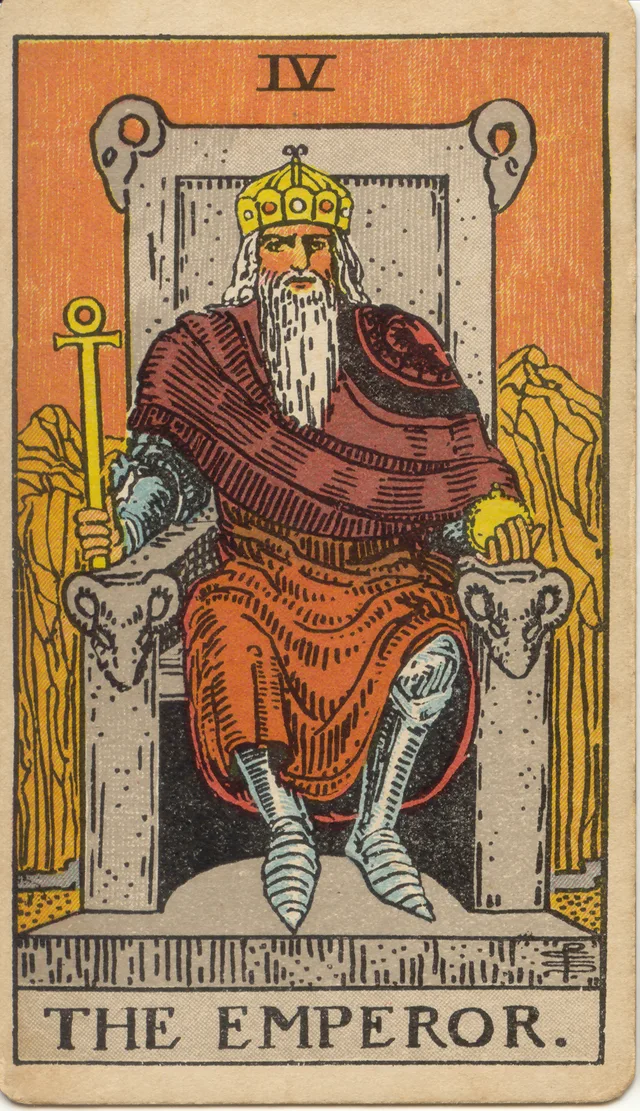
The Emperor
The Emperor explores political and structural authority; the King of Pentacles explores responsibility for money, work and tangible resources. Together they invite a comparison of different kinds of leadership.
Read this card's meaning →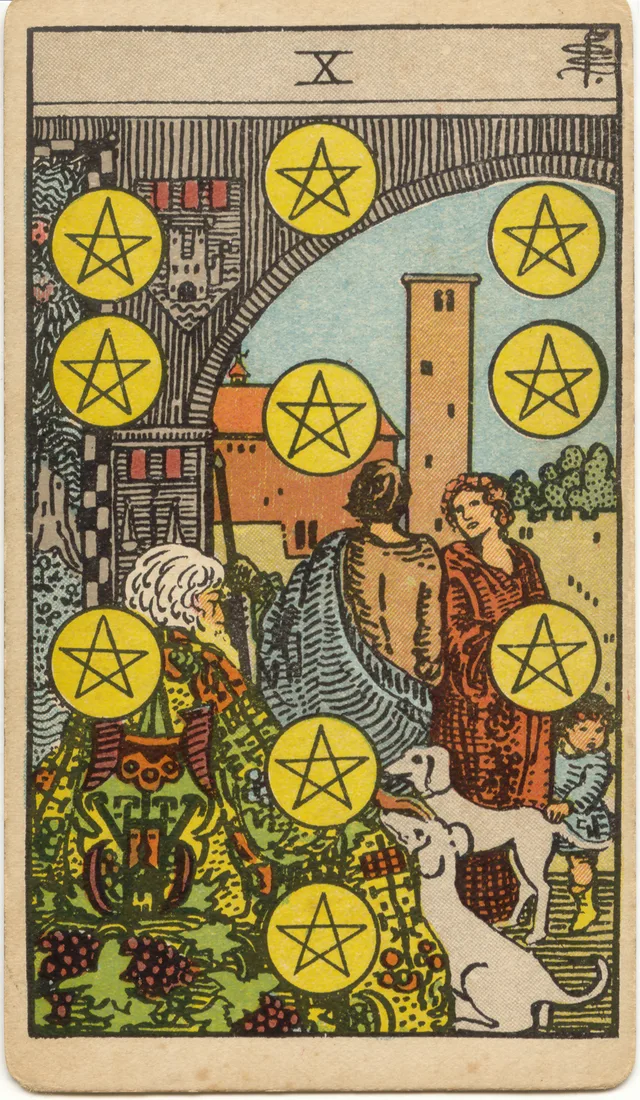
Ten of Pentacles
The Ten of Pentacles widens the discussion from one person's resources to family or community continuity. Beside the King, compare present stewardship with the effects a long project may have on other people.
Read this card's meaning →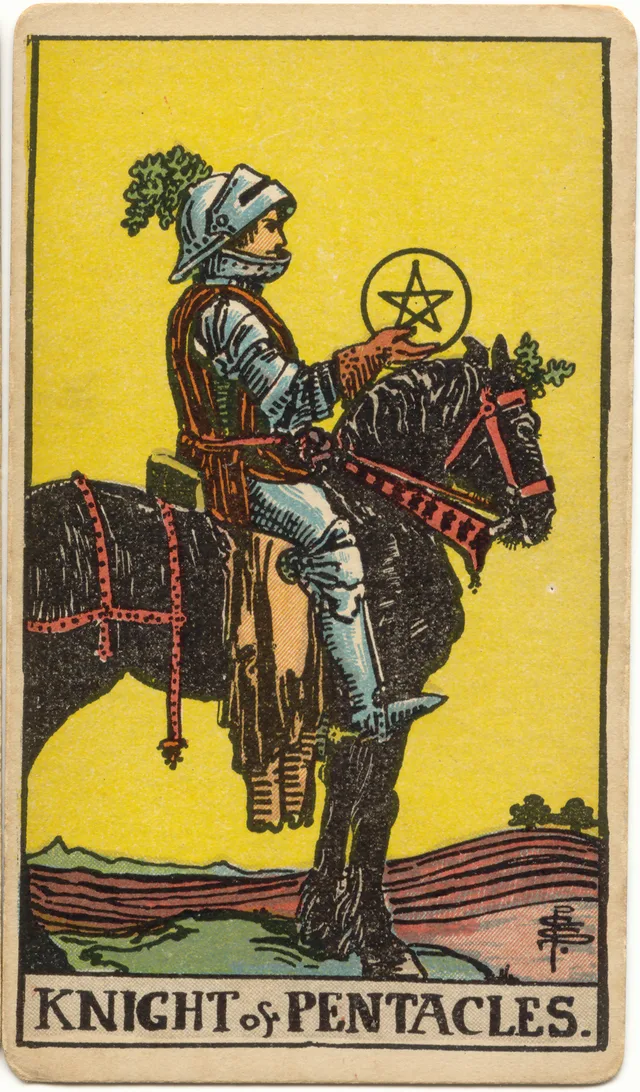
Knight of Pentacles
The Knight of Pentacles focuses on repeatable effort and follow-through; the King focuses on the wider responsibility that can develop after sustained experience. The pairing invites a comparison of process and oversight.
Read this card's meaning →